
A variety of approaches will need to be taken to achieve the ambitions expressed in this section of the plan, including support for High Nature Value farming (traditional low-input farming with a high proportion of semi-natural habitats in a cultural landscape) and also support for the restoration of natural processes across large areas of landscape. See Box 1 Restoring natural processes / ecological function.
The authors of a Natural England guidance note [25], which addresses this theme, note that ‘there is an apparent dichotomy between approaches which aim to conserve and enhance habitats and those which aim to restore ecological function. Extreme portrayals of each (‘species gardening’ on the one hand, and rewilding on the other) obscure the importance of both in biodiversity conservation and the need for an appropriate balance between the two.’
The restoration of natural processes such as a more natural hydrology (by restoring peatland) or a more natural vegetation control (using smaller, mixed flocks and/or control of wild grazers and browsers across a large landscape) should be the approach taken in some landscapes. However, this approach is best avoided in places where high quality examples of semi-natural habitats (like species-rich grasslands) might be affected, unless there is sufficient confidence that restoration measures would result in a net benefit, and that the process of change does not risk elimination of rare species or habitats that are characteristic of the locality.
In North Pennines terms this means that a natural process-led approach to nature recovery needs to be treated with caution in places like Upper Teesdale where there is a high proportion of unique, species-rich semi-natural habitats conserved, in part, by traditional farming.
In summary this approach can be described as a hierarchy:
- Landscape-led – natural process-aware
- Natural process-led – habitat-aware
- Habitat-led – species-aware
Natural England‘s guidance note on this theme [25] states that ‘Effective biodiversity conservation can be hampered by the compartmentalisation of technical advice, guidance, objectives and strategy according to habitat types, species groups and individual species.’ The report attempts to integrate biodiversity decision-making using a natural ecosystem function approach, to deliver greater benefits including enhanced natural assets and greater resilience in our ecosystems.
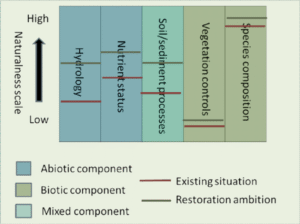
Natural function relates to the operation of ecosystems according to natural processes (abiotic and biotic).
An example of an abiotic process is hydrology. The pathways that water takes through a catchment determine wetness in the landscape and the natural hydrochemistry of water and soils. This has a fundamental bearing on the habitats and species that establish in different places. Disruptions to hydrology (e.g. through drainage and water diversion) change these habitats and species and lead to poor natural function.
An example of a biotic process is vegetation control. In natural systems native herbivores play a key role in determining what habitats and species exist in a landscape. In modified landscapes vegetation control is determined by livestock grazing, cutting and burning. Poor natural function may result from intensive human management (e.g. heavy livestock grazing) or from excessive grazing and browsing by native species due to lack of population control by native predators (removed by human intervention), or from damaging levels of grazing or disturbance by non-native species.
The aim of this approach is to promote the protection and restoration of natural ecosystem function where this is possible and desirable.
In addition to these natural processes, the processes of disturbance and dispersal are also important in helping create dynamic (ever changing) mosaics of closely connected habitats in the landscape.
Natural assets, sometimes referred to as natural capital, can be defined as “the elements of nature that directly or indirectly produce value to people - including ecosystems, species, freshwater, land, minerals, the air and oceans, as well as natural processes and functions”[26]. See Box 1 Restoring natural processes / ecological function.
The table below shows some of the services provided by the natural assets in the North Pennines, and the benefits we all derive from them.
(Table to be redrawn for final version)
| Look after nature and nature looks after us Some of the benefits we all derive when we look after natural assets in the North Pennines | ||
| Building Natural Assets | provides these Services | and these Benefits |
Natural processes Habitats
| Carbon Storage / sequestration Biomass production Pollination Soil stabilisation Nutrient retention and recycling Water retention and filtration Crop and tree pest disease management | Public goods Climate change adaptation and mitigation |
Nature provides us with the services everyone in society needs to live now, and to sustain society in the long term, but only if we look after it. We have often modified our ecosystems, landscapes and environmental processes to manage for just one ecosystem service, such as food from intensive agriculture, and have depleted natural assets as a result. Naturally functioning landscapes, however, are able to support multiple ecosystem services (such as helping to regulate water quality, air quality, flooding and climate) as well as biodiversity.
Together, policy makers, land managers and other actors, can conserve valuable habitats, restore natural processes and increase the diversity and abundance of wildlife. By doing so we will increase biodiversity and underpin its ability to provide the multiple natural services which sustain us.