
Outcome NR5
Outcome NR5
Grassland species-diversity is maintained where high, and enhanced where low
This priority outcome refers to everything from the highly species-rich and rare arctic alpine flora at the highest elevations in the North Pennines, to species-poor pastures on some farms, via limestone grasslands, rush pasture, haymeadows, wood pasture, banks, and road verges.
Species-rich grasslands exist throughout the North Pennines on the margins of rivers and streams, in rush and grass pastures, in quarries and abandoned mine workings and on road and trackside verges, as well as within larger habitat mosaics on higher ground with upland heath and blanket bog. By and large, species-rich swards have developed here in low nutrient or wet conditions and survive where these conditions are preserved, and where the right (often very low) levels of grazing are maintained.
Low nutrient levels are critical to all important grasslands, as high nutrient levels, whether from farmyard manure, inorganic fertiliser or aerial emissions from combustion of fossil fuels, stimulate the growth of fast-growing, robust species of grass and plants such as docks, nettles and thistles, to the detriment of smaller and slower growing species.
The North Pennines also has 40% of the UK's species-rich upland hay meadows. Haymeadows are a result of low-intensity farming practiced over many decades, and the best examples can be very species-rich.
There has been a tendency to undervalue extensively managed pasture compared to meadow, with most grassland creation schemes comprising hay meadow. Pastures can have higher value for invertebrates because of a more varied topography, an ongoing supply of livestock dung (as long as it is free of insecticides such as Ivermectin) and the absence of a hay or silage cut removing most of the above ground vegetation in one go.
Species-richness does not just comprise the plants that live above ground. The soil microbiome should be considered fundamental to the process of restoration and conservation. Continuity of management is often an important determinant of the importance of ecological communities.
New methods in regenerative farming are also reintroducing variety to species-poor swards in some pastures through low-input, pulse grazing systems which focus on regenerating soil microbial activity first, and by introduction of wildflower seed to add floristic diversity, meaning that all grasslands have the potential to increase the biodiversity they support.
Whilst increasing floristic diversity is important, the genetic integrity of existing, and rare, wildflower rich grasslands should be safeguarded. For this reason a zone is defined, within the North Pennines, where seed, for any purpose, should only ever be sourced from with the zone (See Box 8 Grassland restoration zones).
There is a growing consensus that maximum profitability on upland hill farms coincides with lower stocking densities which do not require inputs from outside the farm. Reducing stock numbers to the so called Maximum Sustainable Output (MSO) increases profitability (or minimises losses), benefits nature here by allowing more species rich grassland swards to develop and benefits the environment generally by reducing the need to grow and transport feed from elsewhere [18].
What other natural services does this outcome provide?
Grassland in rotational grazing schemes, where grass is allowed to grow long before intense grazing for a short period, are known to develop a deeper rootzone, and increased infiltration (so less surface run-off in high rainfall events) [42], than short, extensively grazed pasture.
Swards which are lightly grazed - creating structural diversity in vegetation and low soil compaction – are likely to have increased surface ‘roughness’ and increased water infiltration, contributing to natural flood management.
Grassland which is managed without external inputs will not be contributing to water pollution downstream.
Flower-rich swards provide nectar which helps pollinating insects survive.
Which species are supported by this outcome?
Champion species
Black grouse; In-bye wading bird assemblage; Moss carder bee; Violet oil beetle; Arctic alpine assemblage.
Map 4 shows grassland restoration zones, devised to help safeguard the genetic integrity of important areas for species-rich grasslands (see Box 8). Explore Map 4 in a new window.
The North Pennines is divided into two zones for the purposes of safeguarding the genetic integrity of the most important areas for species-rich grasslands.
These important areas are relatively isolated in a UK context, with high moorlands acting as natural barriers and a long history of low intensity farming limiting seed movement or introduction. New agri-environment schemes and Biodiversity Net Gain projects are likely to lead to a big upswing in the restoration of grasslands for biodiversity and there is a danger that, without safeguards, imported seed with non-local or even non-UK provenance will compromise the genetic integrity of these important remnants of species-rich grasslands.
Zone 1 describes the area with the highest concentration of species-rich grasslands, and the area which needs the most protection. It is also the area with the most opportunity for the production of local wildflower seed for restoration projects.
Zone 2 is everything outside of zone 1 and within a 2km buffer of the National Landscape boundary. Zone 2 may also contain scattered species-rich grasslands, but these may be too isolated to benefit from green hay restoration. Brush harvested seed is not yet available either, although it is hoped that the market for this seed, and therefore its production locally, may grow quickly.
Zone 1: In this zone all seed or plants for restoration of grasslands should come from local sources. This means either green hay from suitable donor meadows in zone 1 that can be spread within an hour of harvest or, if green hay unavailable, brush harvested seed from zone 1(within the same catchment if possible). Any plug plants should be grown from seed harvested in zone 1.
This work should be co-ordinated by the North Pennines National Landscape team who will assess meadows for restoration, determine whether a one or two stage process is required (green hay only, or hay/seed plus plug plants), and liaise with potential suitable donors.
Zone 2: In this zone all seeds or plants for restoration of grasslands should come from local or regional sources. Where local green hay, local brush harvested seed, or local provenance plug plants are available, these should be used. Where these are unavailable, seeds and plants should have at least northern England or southern Scotland provenance (for example, Cumbria Wildflowers, Cumbria Wildflower Trust or Kevin Wharf’s Northumberland seed mix (available via British Wildflower Seeds).
The North Pennines National Landscape’s team finds and matches-up suitable green hay seed donor and receptor upland hay meadows. The species-rich donor meadows will be of similar elevation, with similar soil conditions and similar aspect to the receptor meadows. The donor meadows are checked for negative indicator species – areas with species such as creeping buttercup, sharp-flowered rush or soft brome are avoided.
Donor meadows are chosen within a 10-mile radius of the receptor meadow. In order to maintain local genetic provenance, it is not advised to bring in seed from further afield. Donor meadows are usually within the same dale as the receptor meadows, or are found on the same farm.
Donor meadows are found that have good populations of positive indicator species such as: great burnet, ribwort plantain, yellow rattle, eyebright, lesser trefoil, self-heal, pignut, red clover, rough hawkbit and cat’s-ear, plus fine-leaved grasses such as sweet vernal-grass, red fescue, common bent and crested dog’s-tail.
The donor areas are marked out by the North Pennines National Landscape’s team, in discussion with the donor farmer. This exact area will not be harvested again for another four years.
Donor seed (green hay) is spread within an hour of harvesting. The green hay needs to be spread as soon as possible after cutting otherwise the grass starts heating up which destroys the seeds.
The harvesting and spreading takes place over one day, as soon as the receptor meadow has been cut and cleared. It is important that the sward is as short as possible before seed addition.
Harvesting and spreading usually takes place in late July through to the end of August, depending on weather conditions and seed-set. The weather needs to be warm and dry to undertake harvesting of green hay.
A project officer from the North Pennines National Landscape’s team supervises the work and liaises between Natural England, the receptor farmer, the donor farmer and contractors.
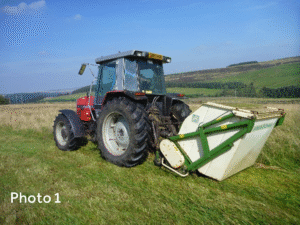
On the day, at the donor site, the harvesting machine called the Amazone Groundkeeper, cuts the vegetation close to the ground and gathers and chops up the vegetation into the bucket (photo 1).
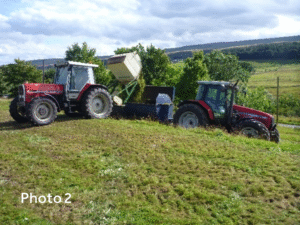
The green hay is tipped into a green hay seed spreader (photo 2). Approximately 0.15ha of green hay equates to approximately 20 bucket loads, which is one trip with the spreader.
The green hay is transported to the receptor meadow in the spreader.
On the day, the receptor meadow is scarified using a spring-tine harrow, creating at least 50% bare ground (photos 3 & 4). It is important to create as much bare ground as possible to aid seed germination. The spring-tine harrow is used on meadows that already have some wildflower interest. These lines quickly disappear after seed addition.
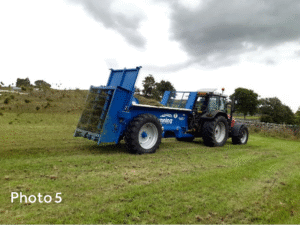
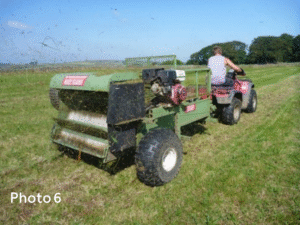
At the receptor meadow, the green hay seed spreader pushes the green hay out of the back, flicking the seed onto the scarified areas (photos 5 & 6).
The meadows must be grazed with livestock once the green hay has been spread, preferably with cattle, or with sheep, or rolled if needed. This tramples the seeds into the ground and aids germination of seeds.


The following protocols and practices should be adopted by all who are engaged in the work of collecting seed and propagating plants from native flora in the North Pennines.
Seed collecting of wild, native plants protocol
- Secure landowner permission for any wild, native plant seeds collected.
- Secure SSSI consent for any wild, native plant seeds collected on SSSI.
- Do not collect and grow any wild, native plants that are on the Schedule Eight, Wildlife and Countryside Act 1981 or Annex 1 EU Habitats Directory. A license is needed to collect, grow and sell these plants.
- Ensure all labelling is accurate and clear, including scientific name, common name, location collected and date collected.
- Ensure that the origin of wild, native plants are certain and keep plants together that are from the same location.
- Keep clear records of landowner permissions, consents and locations of wild, native plants collected.
- Do not collect seed of agricultural crops or vegetables, these seeds require certification.
- Wild, native plant seed collection, growing and selling does not need certification (except for the protected plants), however, best practice should be followed.
Best practice seed collection of wild, native plants
Only collect seeds from a ‘population’ of plants that is over 100. This allows for genetic diversity of plants grown from seed.
A population can be:
- A road verge stretch of approximately one kilometre.
- A footpath stretch of approximately one kilometre.
- A small hamlet/village location such as Holwick, Rookhope, Langdon Beck.
- A farm or holding.
- Only harvest a maximum of 10% of the seeds from each plant. This allows seeds to be collected from the same location in the following year.
- Seeds will be collected in a paper bag and carefully labelled with scientific name, common name, exact location and date of collection.
Best practice seed sorting of wild, native plants
- Separate seeds from the stalks/heads/cases before sowing.
- Throw away seeds that are small or eaten by mites or malformed.
- Choose the biggest and fattest seeds to sow.
- Lightly scarify seeds such as wood crane’s-bill, bush vetch and meadow vetchling using extra-fine sandpaper before sowing.
- Put sorted seeds into envelopes that have been carefully labelled with scientific name, common name, exact location and date of collection, estimating the quantity of seeds in the bag.
- Store seeds in a dark, dry cardboard box away from direct sunlight.
Best practice of seed sowing of wild, native plants
- Sow seed in the autumn.
- Use only peat-free compost.
- Mix peat-free compost with horticultural grit and sand, which aids root development and rooting depth.
- Use a mix of six parts compost, two parts grit to one part sand.
- Do not use small ‘plug’ plants, the plants have a low success rate, and they need constant watering.
- Use 7cm x 7cm pots or bigger. Pot size is dependent on rooting depths, the plants with deep roots like wood crane’s-bill and great burnet will be grown in deeper pots.
- Sow three to five seeds per 7cm pot, covered with a layer of horticultural grit.
- Label each pot with scientific name, common name, exact location and date of collection.
Best practice of looking after wild, native plants - Take care to keep the label in place.
- Keep plants together from the same location.
- Keep plants outside in a sheltered location, free of pests, and sheltered from the wind.
- Water plants as and when required, avoiding drought and waterlogging.
- Look after plants for a year, weeding the pots as and when required.
- Pot-on plants that are too crowded.
Best practice planting of wild, native plants
- Plant into upland hay meadows that are managed traditionally, or similarly managed grasslands.
- Ensure that plants are planted in the same dale, or within a similar location from the where the seeds were collected.
- Plant approximately 650 plants per hectare.
- Plant in the autumn, allowing the roots to grow before the above ground growth.
- Ensure that plants are not grazed by livestock for at least eight weeks after planting.
- Ensure that plants are planted in areas that have low intensity grazing, low intensity spring grazing and late cutting.
- Ensure that if the wildflowers are planted into a community space, a management plan is in place to cut the vegetation at least once a year in September, with the cuttings removed.
Measures for outcome NR5
Select each measure for its full detail and to view the organisations and groups with an important role in making them happen.
Ensure all examples of species-rich grassland habitats are recorded, mapped, protected and monitored as Priority Habitat or as Local Wildlife Site.
| Farmers & land managers | Conservation bodies | National and/or local government |
| • | • | • |
Secure appropriate management on all sites supporting good examples of species-rich grasslands
| Farmers & land managers | Conservation bodies | National and/or local government |
| • | • | • |
Monitor and manage mixed grazing to protect species-rich grassland and mires, and the species they support, including allowing for development of mosaics with upland scrub and trees where appropriate.
| Farmers & land managers | Conservation bodies | National and/or local government |
| • | • |
Continue research into habitat management (grazing) requirements for Arctic Alpine flora.</strong
| Farmers & land managers | Conservation bodies | National and/or local government |
| • | • |
Ensure all Arctic Alpine assemblages are in agri-environment agreements and are being managed according to a strategy informed by the latest research findings.
| Farmers & land managers | Conservation bodies | National and/or local government |
| • | • |
Consider translocation of rare Arctic Alpine species, such as yellow marsh saxifrage, to suitable habitat as restoration progresses, in order to expand range.
| Farmers & land managers | Conservation bodies | National and/or local government |
| • | • |
Cut meadows for hay rather than for haylage and silage whenever the weather allows.
| Farmers & land managers | Conservation bodies | National and/or local government |
| • | • |
Hay-meadow management to follow the protocols below:
• Cut hay meadows in the summer after most of the plants have flowered and set seed, followed by aftermath autumn grazing with cattle.
• Hay-timing should be flexible from year to year allowing for a range of botanical diversity and following natural (and changing) weather patterns.
• Only low intensity spring grazing with an early ‘shut-up’ period should be undertaken. Even earlier shut-up may need to be considered in light of future climate change effects.
• Keep nutrient inputs low - no chemical fertilisers and very low applications of farmyard manure.
| Farmers & land managers | Conservation bodies | National and/or local government |
| • | • |
Restore hay meadows using proven restoration techniques, e.g. those developed by the North Pennines National Landscape team with farmers and contractors, primarily using green hay from species-rich donor sites and plug planting of locally propagated plants. Box 8 describes the geographic zones where it is imperative that local provenance seed and plants are used. Box 9 describes the methodology recommended by the National Landscape team.
| Farmers & land managers | Conservation bodies | National and/or local government |
| • | • |
Develop farmer and contractor capacity for brush harvesting, storing and distributing local wildflower seed to aid with hay-meadow restoration.
| Farmers & land managers | Conservation bodies | National and/or local government |
| • | • |
Consider designation of the North Pennines as a genetic conservation unit for grassland wildflowers
| Farmers & land managers | Conservation bodies | National and/or local government |
| • |
Develop a solution to the local disposal of arisings from road verges to allow conservation management of this important connecting grassland resource. Other than the safety swathe (if required, and which will be regularly close mown) all road verges should be subject to a 'cut and collect' treatment to start to reduce nutrient levels. This treatment will vary with elevation and may require several cuts a year lower down each dale. At the top of the dale this should happen once a year and take place variably between end July and end September. If resources are limited, then this treatment should be targeted at the most species-rich examples first.
| Farmers & land managers | Conservation bodies | National and/or local government |
| • | • |
Spread green hay from species-rich verges without negative indicator species onto species poor verges under the same management regime.
| Farmers & land managers | Conservation bodies | National and/or local government |
| • | • |
Communities and Parish Council could manage and/or create species-rich grasslands on village greens, parks and verges within their control. Box 8 describes the geographic zones where it is imperative that local provenance seed and plants are used.
| Farmers & land managers | Conservation bodies | National and/or local government |
| • | • |
Assist farmers to analyse their business with respect to stocking levels and external inputs, to encourage all farms, groups of farms, and estates to manage land without the need for external input of feed or fertiliser (i.e. moving towards the Maximum Sustainable Output (MSO) [18]).
| Farmers & land managers | Conservation bodies | National and/or local government |
| • | • |
Shift to stocking densities which require no external inputs on farmed land (adopt the MSO approach [18]), normally leading to a reduction in livestock units that would lead to increased sward diversity in most pasture grasslands.
| Farmers & land managers | Conservation bodies | National and/or local government |
| • | • |
Use techniques to increase sward diversity in pastures /allotments, including rotational grazing, green hay introduction, and over-seeding with local provenance wildflower seed. Where farm business objectives make these techniques unfeasible, use of herbal leys to diversify perennial rye grass crops could be considered, but only in zone 2 and where reseeding is a permitted farming practice. Box 8 describes the geographic zones where it is imperative that local provenance seed and plants are used.
| Farmers & land managers | Conservation bodies | National and/or local government |
| • | • |
In extreme cases where species diversity is low and soil fertility high, strip soil or turf before reseeding. Provenance of seed to be guided by grassland restoration zones (see Box 8 Grassland restoration zones)
| Farmers & land managers | Conservation bodies | National and/or local government |
| • | • |
Reduce use of worming medicines such as Ivermectin to protect species diversity (flora and soil microbiome), through techniques such as faecal egg count monitoring to target treatment, mixed grazing to reduce worm load in pasture, and bioactive forages to protect animals [43].
| Farmers & land managers | Conservation bodies | National and/or local government |
| • | • |