
Key characteristics
- Rolling foothills and foot-slopes of the Pennine uplands incised by minor river valleys.
- Triassic sandstones of the foothills and lower foots-lopes give way to carboniferous limestones, siltstones and sandstone on higher ground.
- Steeper slopes and higher ground are largely free of drift. On lower ground the bedrock is masked by tracts of glacio-fluvial sands and gravels with later alluvium and river terrace sands and gravels in the valleys.
- Soils are a mosaic of clayey loams on till and sand and sandy loams on sandstone bedrock and sand & gravel drift.
- Agricultural land-use is predominantly pasture.
- Old field systems with sub regular or linear patterns of hedges and walls lie close to historic villages.
- Relics of rig and furrow, and cultivation terraces.
- Later field systems with regular grids of hedges and walls elsewhere.
- Scattered blocky plantations and shelter belts.
- River valleys contain corridors of woodland, including ancient oak woods in incised gills, wood pasture and tree lines.
- A settled landscape of old villages strung out in a chain along the foot of the Pennines.
- Scattered farmsteads.
- Older buildings of farms and villages built of red sandstone
- Narrow winding lanes and straight enclosure roads
- Locally enclosed by trees and hedgerows but often with long open views to the west and rising fells prominent to the east.
- A tranquil settled rural landscape with a strong sense of cultural continuity.
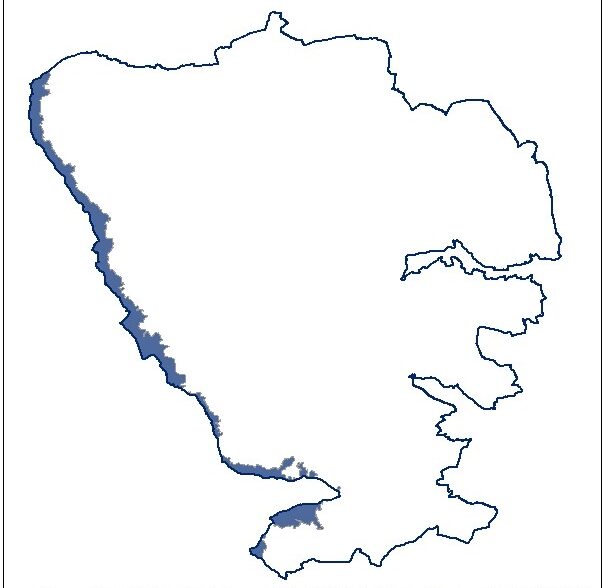
Description
An upland fringe landscape made up of rolling foothills and foot-slopes along the western edge of the North Pennines that form part of the Eden Valley National Character Area (NCA 6) which lies largely outside of the National Landscape. The topography is varied, a mixture of rolling terrain and hill slopes incised by the valleys of rivers and becks flowing westwards to the Eden. Triassic sandstones of the foothills and lower foots-lopes give way to carboniferous limestones, siltstones and sandstone on higher ground. Steeper slopes and higher ground are largely free of drift. On lower ground the bedrock is masked by tracts of glacio-fluvial sands and gravels with later alluvium and river terrace sands and gravels in the valleys. Soils are a mosaic of clayey loams on till and sand and sandy loams on sandstone bedrock and sand & gravel drift.
Agricultural land-use is predominantly pasture. Field boundaries are a mixture of hedges and walls dating from successive periods of enclosure. Old field systems with sub regular or linear field patterns lie close to historic villages together with relics of rig and furrow and older cultivation terraces. Later field systems with regular grids of ‘surveyor enclosed’ field systems lie in areas between.
The landscape is open in places but well-wooded in others with scattered blocky plantations and shelter belts. The river valleys contain corridors of woodland, including ancient oak woods in incised gills, together with areas of wood pasture and tree lines. The landscape has a long history of settlement, with a chain of old linear or ‘green’ villages strung along the foot of the Pennines connected by narrow winding lanes. Older buildings are built of distinctive red sandstone with slate roofs. Scattered farms lie in areas between the villages, often in areas of later enclosure served by narrow straight enclosure roads. The busy trans-Pennine A66 crosses the area in the south. There are a number of active quarries worked primarily for roadstone. A military training area occupies a large area of land at Warcop. The landscape is visually open in places with long views to the east, locally enclosed by trees and hedgerows. The rising fells, scarps and pikes of the North Pennines often figure prominently in views to the west, underlining the strong connections with that landscape. There is a well-developed network of public right of way, often on old historic routes, including trails up into the western fells. A remote and generally tranquil settled rural landscape with a strong sense of cultural continuity.
Measures: land management
Natural features
See Nature Recovery section, outcomes NR1,NR3, NR4 and NR5, for main measures relating to peatland and heathland, trees and woodland, rivers and streams and grasslands.
Cultural features
Conserve and maintain traditional farm buildings.
- Protect archaeological features including rigg & furrow, cultivation terraces and lynchets from damaging activities such as cultivation, overstocking, or poaching.
- Conserve and enhance old quarries by avoiding tipping and excluding livestock to promote natural regeneration. Maintain access to geological exposures.
Field Boundaries
- Protect, restore and maintain existing dry-stone walls and hedgerows. Reinstate hedges and walls where they have been replaced by fences.
Measures: development
Agricultural buildings
- Site new farm buildings close to existing buildings where possible, and reflect their scale, character and materials.
- Reduce the impact of larger modern buildings by careful selection of colour, breaking up mass and planting screening belts of native species. Follow the North Pennines National Landscape Planning and Design Guidelines.
Housing and economic development
- Protect and conserve the character of villages by ensuring that new development respects their scale, structure, vernacular character, detailing and materiality.
- Retain and enhance open green spaces within villages, and particularly village greens, old gardens and orchards, and tofts or garths.
Energy, telecommunications & infrastructure
- Avoid the siting of tall structures such as masts, pylons and wind turbines in the Upland Fringe Foothill landscape generally.
- Where masts, pylons or domestic scale wind turbines are needed, site them close to existing buildings or woodland edges and avoid sensitive skylines.
- Avoid the development of new overhead services. Where possible underground new or existing services.
Minerals & waste
- Avoid damage to sensitive natural landforms.
- Avoid extraction on prominent slopes or breaching local skylines with extraction areas or storage mounds.
- Restore quarry faces to naturalistic profiles using restoration blasting.
- Restore quarries to semi-natural woodland, grassland, wetland and bare rock habitats using natural regeneration where appropriate.
Tourism & recreation
- Tourism and recreational development should be undertaken in such a way as to avoid any urbanising influence on the landscape. Existing buildings should be re-used where possible. New buildings should, where possible, reflect the scale, form, materials and vernacular detailing of traditional farm buildings in the area.
- Facilities like chalets and caravan parks should only be developed or extended where there is a high degree of year-round visual containment – either from the topography or robust woodland cover – so that they do not detract from the rural character and scenic quality of the area.