
Key characteristics
- High moorland summit ridge
- Millstone grits form distinctive flat-topped summits
- Carboniferous rocks largely masked by deep peat which is exposed in eroded hags and peat edges
- Millstone grits outcrop locally in summits, gullies, stone bands and stone piles
- Tracts of shake holes follow outcrops of limestone
- Continuous blanket bog of sphagnum mosses, cotton grasses and dwarf shrubs
- Scattered peaty tarns and shallow meandering sykes
- Networks of moorland grips, many being restored with check dams
- Burning patterns in some places create a patchwork of older and younger heather
- Few human-made features other than very occasional fences, grouse butts, cairns and sheepfolds
- Extensive grazing by hardy hill sheep
- A remote and inaccessible landscape with no roads and few tracks.
- A broad scale landscape with long distance views across moorland ridges and valleys to the east and the Vale of Eden to the west.
- An exposed, elemental and simple, often bleak, landscape with a near wilderness quality.
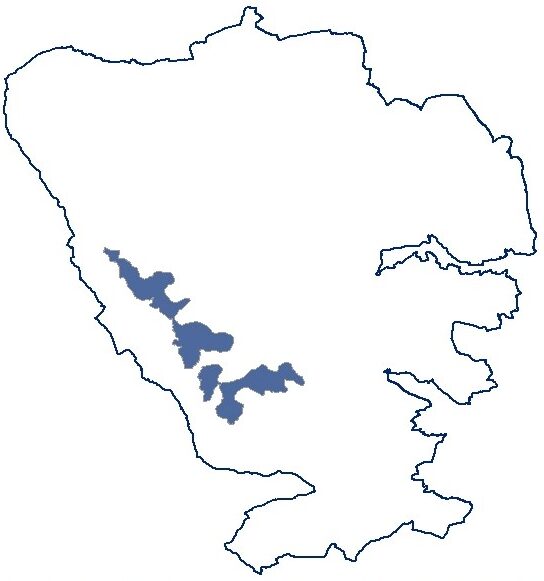
Description
The high summit ridge of the North Pennines. Hard millstone grits form cap the highest fells, forming discrete flat-topped summits. Thick layers of peat cover much of the terrain, the underlying rocks outcropping locally to form low grey scars, stone bands and stone piles. Tracts of shake holes follow outcrops of limestone. The land is covered by blanket bog of sphagnum mosses, cotton grasses and dwarf shrubs, drained by shallow meandering ‘sykes.’
On flatter ground there are scattered peaty tarns, occasionally forming larger mosaics of bog and mire. Thick peats are exposed as dark eroding peat edges and hags and are drained in places by complexes of moorland grips, many of which are being restored with peat dams and check weirs. The moors are managed locally for grouse shooting and the extensive grazing of the hardiest of upland sheep. The landscape is largely devoid of human-made features other than occasional fences, grouse butts, cairns, sheepfolds and shelters. There are no roads and only occasional access tracks.
The remains of C18th and C19th ore mining - including mines, levels, hushes, and small waste heaps – can be found locally following the line of ore-bearing veins. The landscape is very large in scale and visually open with panoramic long-distance views out across moorlands ridges, valleys and plateaux to the east and across the Vale of Eden to the coast and the Lake District fells to the west. The visual simplicity of the landscape coupled with a severe climate of high rainfall, cold winters and short summers gives it an austere and elemental character and a near wilderness quality.
Measures: land management
Natural features
See Nature Recovery section, Outcome NR1, for main measures relating to peatland and heathland. Additional measures are listed below.
- Protect natural rock outcrops, screes, stone bands & shake holes by preventing disturbance, stone removal or cairn building.
- Manage access by encouraging the use of structured and seasonal paths to decrease pressure on fragile substrates and avoid disturbance to breeding birds.
- Maintain the open treeless character of the landscape.
Cultural features
- Conserve and restore isolated moorland structures like sheepfolds.
Measures: development
Energy, telecommunications & infrastructure
- There should be no built structures on the moorland summits other than drystone walls and sheep folds
Tourism & recreation
- Manage access to decrease pressure on fragile substrates and avoid disturbance to breeding birds.