
Key characteristics
- Broad divided ridges.
- A strong horizontal grain to the topography.
- Grits and limestones outcrop locally in low grey crags and stone bands.
- Hard igneous dolerites outcrop in larger crags and scree slopes.
- Rocky, quick flowing becks or burns in steep-sided gullies.
- Extensive tracts of blanket bog of sphagnum mosses, cotton grasses and dwarf shrubs.
- Deep peat exposed in eroded hags and peat edges.
- Drier slopes clothed in upland heath of heather and bilberry or acid grasslands.
- Extensive grazing by hardy hill sheep.
- Burning patterns on grouse moors create a patchwork of older and younger heather.
- Few human-made features other than occasional fences, grouse butts, cairns and sheepfolds.
- Unfenced roads marked by snow poles with gates or cattlegrids at the moor wall.
- Relics of lead mining: mines, hushes, waste heaps, railways, reservoirs and water leats, smelter flues and chimneys.
- Panoramic long-distance views out across unbroken moorlands or adjoining dales.
- A remote and elemental landscape with a near wilderness quality in places.
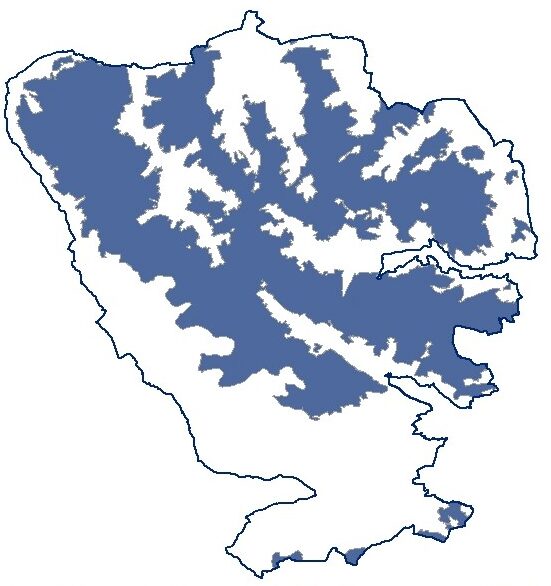
Description
Remote upland landscapes of elevated moorland ridges and valleys. The topography of the landscape is heavily influenced by its geology. Alternating strata of Carboniferous limestones, sandstones and softer shales give a stepped profile to slopes and a strong horizontal grain to the topography. Thick layers of peat cover much of the terrain but underlying rocks outcrop locally to form low grey scars and stone bands. Igneous dolerites of the Great Whin Sill form prominent crags and screes. Ridges are broad and deeply divided by valleys on their flanks, drained by rocky, quick-flowing becks or burns in steep sided gullies – gills or sikes. Thick peats are exposed as dark eroding peat edges and hags.
The highest ground is occupied by extensive tracts of blanket bog of sphagnum mosses, cotton grasses and dwarf shrubs. This gives way on peaty gleys and podzols to heathland or acid grassland. The moors are managed for grouse shooting and the extensive grazing of hardy upland breeds of sheep like Swaledales. On heavily grazed moors heather is replaced by ‘white moor’ dominated by Mat-grass. Burning patterns on grouse moors create a patchwork of older and younger heather, creating a diversity of colour and texture.
The landscape is largely devoid of human-made features other than occasional fences, grouse butts, cairns, sheepfolds and bields. Roads across the moor are unfenced and marked by snow poles with gates or cattlegrids at the moor wall. Occasional radio and telecommunications masts break the skyline.
Relics from the Bronze Age survive in a few places in the form of stone circles, cairn fields and burial mounds – these are generally cryptic features, difficult to find in the moorland heather. Remains of the C18th and C19th lead mining industry - including mines, mine entrances, derelict mine buildings, waste heaps, reservoirs and water leats - can be found on some moors following the line of ore-bearing veins. The most prominent in the landscape are smelter flues and chimneys and the deep hushes which scar the hillsides and occasionally notch the skyline.
The landscape is visually open with panoramic long-distance views out across unbroken moorlands or adjoining dales. The visual simplicity of the landscape coupled with a severe climate of high rainfall, cold winters and short summers gives it an austere and elemental character. In the heart of the moorlands, where human-made features are few, the landscape has a near wilderness quality.
Measures: land management
Natural features
See Nature Recovery Section, Outcomes NR1, NR3 and NR4 for main measures relating to peatland and heathland, trees and woodland, rivers and streams. Additional measures are listed below:
- Protect natural rock outcrops, screes, stone bands & shake holes by preventing disturbance, stone removal or tipping.
- Manage access by encouraging the use of structured and seasonal paths to decrease pressure on fragile substrates and avoid disturbance to breeding birds.
Cultural features
- Protect archaeological features by avoiding overstocking and supplementary feeding on sensitive sites.
- Conserve and restore moorland structures like sheepfolds, bields and bothies.
- Protect and conserve lead mining features – avoid physical damage, removal or infilling, consolidate important structures; sensitively gate open shafts and adits.
Measures: development
Energy, telecommunications & infrastructure
- Avoid the siting of tall structures such as masts, pylons and wind turbines in the Moorland landscape generally - in particular avoid prominent skylines.
- Locate masts or pylons in the moorland fringe close to existing buildings or forest edges.
- New buildings should only be developed in exceptional circumstances - they should be sited to minimise visibility, be built of natural materials, and where possible designed to look like traditional moorland features – bields, bothies or sheepfolds
Minerals & waste
- Avoid damage to sensitive natural landforms
- Avoid breaching skylines with extraction areas or storage mounds
- Restore quarry faces to naturalistic profiles using restoration blasting
- Restore quarries to semi-natural heathland, grassland, wetland and bare rock habitats using natural regeneration where possible
Tourism & recreation
- Manage access to decrease pressure on fragile substrates and avoid disturbance to breeding birds.
- Facilities and infrastructure for tourism and recreation – paths, car parks, litter bins, signage and interpretation - should be provided only where absolutely necessary and should be sensitively designed and low key to avoid exerting an urbanising influence on the landscape.