
Key characteristics
- Upland landscape of improved moorland fringes, intakes and allotments
- Varied topography including valleys and upper dale sides
- Carboniferous rocks bare of drift or covered by boulder clays
- Hard igneous dolerites outcrop locally in low crags
- Shallow, infertile or waterlogged peat soils
- Wet, rushy pastures, rough grazing and enclosed moorland
- Large regular fields bounded by low stone walls and wire fences
- Isolated farms connected by straight roads
- Scattered conifer plantations and shelterbelts - occasional large tracts of commercial forestry
- Relics of the lead mining industry – mine buildings, waste heaps, smelter flues, reservoirs and hushes
- Visually open and often broad in scale with extensive views across adjacent dales and moors
- A remote and tranquil landscape on the margins of settlement and agriculture
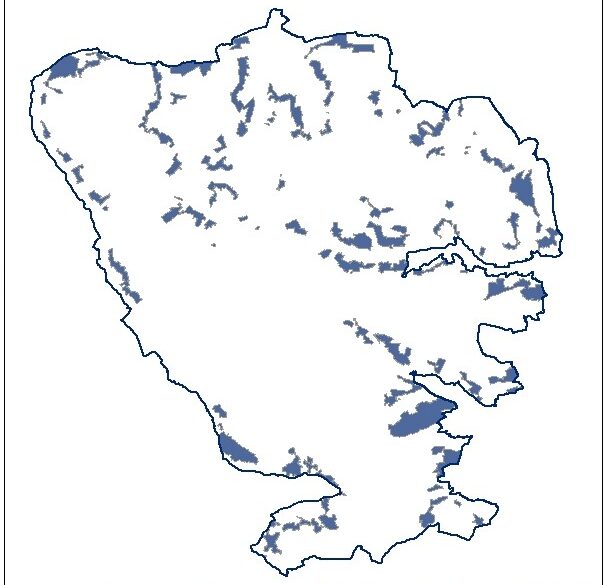
Description
An upland fringe landscape of marginal land lying between the open moors and the more settled, fertile dales. The topography of the moorland fringe is varied and includes minor valleys branching off the main dales and the upper slopes of the dale sides. On the convex slopes of higher dale sides Carboniferous sandstones, limestones, mudstones and shales are bare of drift and the terrain often has a stepped quality reflecting the alternating strata of harder and softer rocks. On lower ground these are masked by glacial drift of boulder clays. Soils are impoverished and often waterlogged - peaty gleys, podzols and heavy surface water gleys.
This is a pastoral landscape of wet, rushy pastures and rough grazing of acid grassland, enclosed from moorland wastes in successive waves of agricultural improvement and expansion since the late C18th. Regular grids of parliamentary enclosures or larger moorland intakes are bounded by low dry-stone walls or wire fences.
The diversity of grasslands, grazed by hardy upland sheep and beef cattle, creates a patchwork of muted and brighter greens reflecting varying degrees of improvement by drainage, liming, and fertilising.
The landscape is sparsely settled with a scattering of isolated farmsteads dating from the period of enclosure – most are small and built of stone with roofs of stone flag or slate. In Teesdale the farms and field barns of the Raby estate in Teesdale are painted white. Roads and tracks also date from the period of enclosure and are characteristically straight and uniform in width.
The landscape is generally open with few trees or woodlands. There are occasional clumps of sycamore planted as shelter trees around exposed farms, and scattered conifer plantations and shelterbelts. Parts of the moorland fringe have been given over to larger scale forestry with large Forestry Commission holdings at Hamsterley Forest and The Stang.
Relics of the lead mining industry are common in parts of the moorland fringe. Some of the enclosures and farmsteads date from the expansion of the lead industry and the miner-smallholder economy it generated. Derelict mine buildings, waste heaps, smelter flues, reservoirs and hushes are locally prominent features.
The landscape is visually open and broad in scale with extensive panoramic views across adjacent dales and moors. A remote and tranquil landscape on the margins of settlement and agriculture, often with a neglected ‘run-down’ quality.
Measures: land management
Natural features
See Nature Recovery section, Outcomes NR1, NR3, NR4 and NR5, for main measures relating to peatland and heathland, trees and woodland, rivers and streams and grasslands. Additional measures are listed below.
- Restructure forests and plantations to restore damaged archaeological sites and soften geometric outlines
- Consider removal of visually intrusive isolated plantations
- Conserve and reinforce stands of shelter trees around isolated farmsteads
Cultural features
- Protect archaeological features by avoiding overstocking or supplementary feeding on sensitive sites
- Protect and conserve lead mining features – avoid physical damage, removal or infilling; consolidate important structures and sensitively gate open shafts and adits taking archaeological advice
- Conserve and maintain historic field barns, farm buildings and lime kilns
- Conserve and enhance old quarries by avoiding tipping and managing livestock grazing sensitively
Field boundaries
- Maintain and restore dry stone walls
Measures: development
Agricultural buildings
- Site new farm buildings close to existing buildings where possible, and reflect their scale, character and materials
- Reduce the impact of larger modern buildings by careful selection of colour, breaking up mass and planting screening belts of native species. Follow the North Pennines National Landscape Planning and Design Guidelines
Energy, telecommunications & infrastructure
- Avoid the siting of tall structures such as masts, pylons and wind turbines in the Moorland Fringe landscape
- Where masts, pylons or domestic scale wind turbines are needed, site them close to existing buildings and forest edges. Where possible underground services
- New buildings should only be developed in exceptional circumstances - they should be closely related where possible to existing buildings and should utilise traditional materials and building styles
Mineral workings
- Avoid damage to sensitive natural landforms
- Avoid breaching skylines with extraction areas or storage mounds
- Restore quarry faces to naturalistic profiles using restoration blasting
- Restore quarries to semi-natural woodland, grassland, wetland and bare rock habitats using natural regeneration where appropriate
Tourism & recreation
- Tourism and recreational development should be undertaken in such a way as to avoid any urbanising influence on the landscape. Existing buildings should be re-used where possible. New buildings should complement their settings and should consider the scale, form, materials and vernacular detailing of traditional farm buildings in the area
- Facilities and infrastructure for tourism and recreation – paths, car parks, litter bins, signage and interpretation - should be provided only where absolutely necessary and should be sensitively designed and low key to avoid exerting an unduly urbanising influence on this very rural landscape