
Key characteristics
- Broad upland valleys with moderately sloping, often gently stepped valley sides, incised by narrow steep-sided gills.
- Carboniferous rocks overlain on lower slopes by boulder clays. Hard igneous dolerites outcrop locally in prominent scars.
- Narrow floodplains of alluvium or glacial sands and gravels.
- Rocky fast flowing rivers and streams.
- Heavy, often waterlogged, clay soils with more fertile brown earths on valley floors.
- Improved and semi-improved pastures and flower-rich upland hay meadows.
- Strong regular or sub-regular patterns of dry-stone walls with occasional ash, oak and sycamore field trees.
- Sparsely wooded. Narrow ash and oak-birch woodlands along rivers and streams and dale side gills. Scattered plantations of pine, larch or spruce.
- Small villages, hamlets and farm clusters follow valley floor roads – scattered farms and field barns on the dale side. Buildings of local stone with roofs of stone flag or slate.
- Active and abandoned limestone and whinstone quarries prominent on the dale side.
- Relics of the lead (and locally coal) mining industry – mine buildings, waste heaps, smelter flues, reservoirs and hushes.
- Major reservoirs in some dales.
- Visually open but enclosed by encircling moorland ridgelines.
- Settled tranquil upland landscapes with a strong sense of cultural continuity.
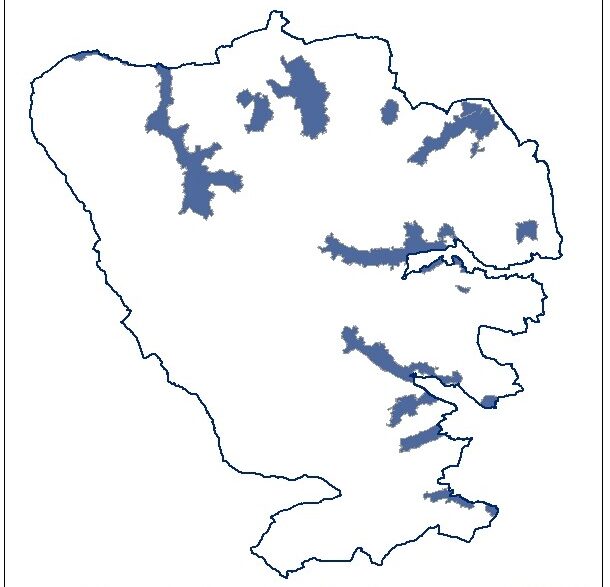
Description
Broad upland valleys with moderately sloping valley sides, incised by narrow steep-sided gills. Alternating strata of Carboniferous limestones, sandstones and softer shales and mudstones give a gently stepped profile to the upper dale side in places. On lower slopes they are overlain by boulder clays. Hard igneous dolerites with a vertical columnar grain outcrop locally in prominent scars. Rocky fast flowing rivers and streams with braided boulder-strewn channels run through narrow floodplains of alluvium or glacial sands and gravels. Locally, outcropping dolerites form spectacular waterfalls. Soils are heavy, often waterlogged clays with more fertile brown earths on the valley floors.
Improved and semi-improved pastures, occasionally rush-infested, and flower-rich upland hay meadows cover the valley floor and dale side. Field systems are regular or sub-regular in pattern and date largely from C18th and C19th enclosures. Strong patterns of dry-stone walls are prominent features of the dale-side. Walls are of locally quarried sandstones, limestones and whin stone, or rounder boulders from riverbeds and field clearances. Tree cover is generally sparse with scattered field and shelter trees of ash, oak and sycamore.
The middle dale is generally sparsely wooded, with narrow ash, alder or oak-birch woodlands along rivers and streams, in dale side gills or on steeper dale sides. Plantations of pine, larch or spruce are scattered across the dale side, with localised concentrations creating some heavily wooded local landscapes.
Small villages, hamlets and farm clusters follow valley floor roads. Many of these have their origins in the lead mining industry, as do many of the small farms that line the dale sides, often close to the moor wall at the limits of agriculture. Buildings are of local stone with roofs of stone flag or slate and have a strong vernacular character.
Other legacies of the lead mining industry include mine buildings, waste heaps, smelter flues, reservoirs and deep hushes which scar the dale side. Active and abandoned quarries are prominent on the dale side following outcrops of the Great Limestone and the Great Whin Sill. Large water supply reservoirs occupy a number of dales.
The landscape is visually open but enclosed by encircling moorland ridgelines. A settled and largely tranquil upland landscape that, with its vernacular buildings, field boundaries and traditionally managed meadows and pastures, has a strong sense of both visual unity and cultural continuity.
Measures: land management
Natural features
See Nature Recovery Section, Outcomes NR3, NR4 and NR5, for main measures relating to peatland and heathland, trees and woodland, rivers and streams and grasslands.
Cultural features
- Protect archaeological features by avoiding overstocking or supplementary feeding on sensitive sites.
- Protect and conserve lead mining remains – avoid physical damage, removal, infilling or tree planting. Restore or consolidate important structures and gate open shafts and adits taking archaeological advice.
- Conserve and maintain historic field barns, farm buildings and lime kilns.
- Conserve and enhance old quarries by avoiding tipping and excluding livestock to promote natural regeneration. Maintain access to geological exposures.
Field boundaries
- Maintain and restore dry stone walls. Restore roadside walls where they are damaged or derelict and reinstate them where they have been removed.
Measures: development
Agricultural buildings
- Site new farm buildings close to existing buildings where possible, and reflect their scale, character and materials.
- Reduce the impact of larger modern buildings by careful selection of colour, breaking up mass and planting screening belts of native species. Follow the North Pennines National Landscape Planning and Design Guidelines.
Energy & infrastructure
- Avoid the siting of tall structures such as masts, pylons and wind turbines in the Middle Dale landscape generally.
- Where masts, pylons or domestic scale wind turbines are needed, site them close to existing buildings or woodland edges and avoid sensitive skylines. Where possible underground services.
Minerals & waste
- Avoid damage to sensitive natural landforms.
- Avoid extraction on prominent dale side slopes or breaching local skylines with extraction areas or storage mounds.
- Restore quarry faces to naturalistic profiles using restoration blasting.
- Restore quarries to semi-natural woodland, grassland, wetland and bare rock habitats using natural regeneration where appropriate.
Tourism & recreation
- Tourism and recreational development should be undertaken in such a way as to avoid any urbanising influence on the landscape. Existing buildings should be re-used where possible. New buildings should reflect the scale, form, materials and vernacular detailing of traditional farm buildings in the area.
- Facilities and infrastructure for tourism and recreation – paths, car parks, litter bins, signage and interpretation - should be sensitively designed and low key to avoid exerting an urbanising influence on this rural landscape.
- Facilities like chalets and caravan parks should only be developed or extended where there is a high degree of year-round visual containment – either from the topography or robust woodland cover – so that they do not detract from the rural character and scenic quality of the area.